Why Regional Australia GP May Offer You More Than City Life

Why You Should Consider Working as a GP in Regional Cities Rather Than State Capitals in Australia

Australia offers a range of opportunities for GPs, but the bustling metropolitan hubs like Sydney, Melbourne, and Brisbane aren’t the only places where careers can thrive. Over the past few years, regional cities across the country have gained increasing attention, not just for their unique charms and lifestyle benefits, but for the professional opportunities they offer as well.

Similar to the UK, there is a large proportion of the population live away from the State capitals; how many of you live in London?

If you’re considering a lifestyle change, here are some compelling reasons why working in a regional city might be the best decision for you.

A Better Work-Life Balance

One of the most attractive features of working in regional cities is the superior work-life balance. Many regional cities enjoy DPA status so there is no long commute to enjoy that beachside lifestyle and after work swim.

In regional cities like Geelong, Ballarat, or Newcastle, you’ll find that the overall pace of life is more relaxed. This slower rhythm allows for more flexible working hours, more leisure time, and a stronger emphasis on family and community, making it ideal for those who value quality of life.

Affordable Housing

The cost of living in major cities has skyrocketed in recent years, particularly when it comes to housing. In Sydney or Melbourne, property prices are at all-time highs.

In regional cities, on the other hand, housing is far more affordable. Whether you’re looking to buy or rent, you’ll find that your dollar stretches further in places like Cairns, Bunbury, or the Central Coast.

DPA Availability

The majority of Regional cities in Australia are DPA, even within central suburbs. Therefore, no requirement to be a certain distance from the city centre. Cities such as Newcastle, Geraldton, Mackay and Townsville offer regional airports with easy links around Australia and to the state capitals.

Lower Cost of Living, More Disposable Income

In addition to affordable housing, other living costs in regional cities tend to be lower compared to state capitals. Groceries, dining out, utilities, and even transport costs can all be cheaper. As a result, you’re more likely to find that your salary goes further.

Closer to Nature and Outdoor Adventures

If you love the outdoors, regional cities offer an unbeatable lifestyle. Australia’s regional areas are home to some of the most stunning landscapes, from coastal regions to national parks, bushland, and mountain ranges. Imagine being able to take a quick hike before work or enjoy a beach day after a long week of work.

Whether it’s the surf breaks on the Gold Coast, the wineries of the Barossa Valley, or the hiking trails of Tasmania, regional areas offer a richness of natural beauty that’s harder to come by in the more urbanised capitals.

Final Thoughts: Embrace the Regional Advantage

While working in a state capital may still seem like the gold standard for many, the benefits of working in regional cities across Australia are becoming impossible to ignore. From better work-life balance and affordable housing to career opportunities and strong community connections, regional Australia offers a lifestyle that’s hard to match in the hustle and bustle of the big cities.

Whether you’re seeking a quieter, more fulfilling lifestyle, or you’re ready to explore new career opportunities outside the capital cities, regional cities in Australia could offer you the fresh start you’ve been looking for.

Take a look at some of our top regional jobs:

Regional town, 1 hour from Sunshine Coast

Regional Victoria, 3 months accommodation

Bunbury, South of Perth, 20K relocation assistance

Please get in touch if you would like to discuss areas around Australia and where would fit best with your lifestyle needs. We’ve travelled and lived in Australia so can provide advice and support from day one of your transition to Australia.
How to Guarantee a Steady Income from GP Billings – Australia

Australia GP Billings

 When considering your relocation to Australia, you will be thinking about better opportunities for your family, better weather and lifestyle.

You must also consider your professional interests and decide what is important to you in choosing a practice. There are many great options, and it may feel difficult to narrow down which practice is best.

Australian General Practice

Australian and UK general practice is very different in terms of health system and practice model. Working as a GP in Australia is varied and challenging and will provide professional satisfaction. It is however, a very different way of working.

Working as an Independent Contractor

In Australia, rather than being salaried or earning a fixed session rate, GPs get paid a percentage of the total amount they bill in the practice. Most practices offer GPs 65% – 70% of billings. Your income will therefore depend not only on the number of patients you see but also on the complexity of the consultations.

GPs in Australia generally earn a good income and can afford a comfortable lifestyle. In the majority of cases, relocating from the UK, you will earn at least the same for doing fewer hours per week.

‘Life in Australia – people are friendly, you see fewer patients and have longer appointment times for more pay.’ (Dr Emma, Brisbane)

Established GPs earn a very good income, an average of $300K per annum is reasonable allowing for 6 weeks leave and working 4 or 5 days per week. Some doctors earn much more than this. Figures from a 2024 industry report stated that GPs average around $360 – $380K per year. This figure reflects a full time working week.

The RACGP provide an Australia GP Billings calculator on their website

Will I Make Enough Money As a GP In Australia?

Australia GP practice is not like the NHS, where there the demand is always there and GPs are guaranteed an income irrespective of the number of patients seen.

To be successful and build a good income, GPs must understand Australian general practice and Australia GP Billings. Initially, you build up your patient base by making yourself available when patients are, this can potentially mean initially doing a weekend shift or working earlier or later in the day to catch commuters.

Ensuring you give a good service to encourage patients and their families to come back to you and gaining an understanding of the billings is crucial. It is essentially your own business and your patient base must be built up.

How Can The Practice Support Me?

In order to achieve this, a practice must have enough patients. There should either be a waiting list of patients or enough demand in the local area that, with advertising of a new GP, you should be up and running fairly quickly.

The interview process gives you the opportunity to probe these questions and to be reassured that there are enough patients to allow you to be booked up.

  • How will you promote me as a new GP in the practice?
  • Has the practice closed their books?
  • Has a recently GP left / retired?
  • Is there growth in the local population which will increase patient demand?
  • Or simply, does the current patient demand outstrip the number of current GPs?

Bookings are quite different from the UK where there is usually quite a wait to see a GP. That’s not always the case in Australia and patients book on the same day. I discussed this recently with a practice  in Brisbane. He has quite a large number of ’empty slots’ during the week however he said in reality, he rarely has empty time and bills incredibly well.

Practices spend a lot of money in recruiting a GP from overseas. There are sponsorship fees, professional fees (agency, immigration advisor etc), relocation assistance, plus the time involved with recruiting and supervising a new doctor within the practice. It is not in a practice’s interest to have a GP in a room not earning money. This is lost income, not only for the GP, but the practice also.

How Transition Medical Can Help

We spend time getting to know the clinic, so we can as best possible, match you up with your perfect practice.

We don’t work with every practice in Australia! If we feel that the practice cannot offer enough patient numbers or support in making the transition from UK to Australia GP then we won’t work with them. We want to ensure you have a long and happy career within the practice. Our support is available throughout your relocation process and thereafter.

That being said, it’s so important for you to get to get to know the practice and make sure it’s the right fit for you. The only way to do this is to have a face to face online chat and find out more.

If you want to talk about any of our current jobs or have any questions please do get in touch. We’re here to help!

Further Reading

Australia FAQs

How much do GPs earn in Australia


AHPRA Expedited Pathway now open!

New Pathway Now Open for Specialist IMGs

The new AHPRA expedited specialist pathway is available to specialists with qualifications from the UK, Ireland, and New Zealand.

Following the launch of the new pathway on 21st October, we can now share some further information and help answer some of your questions.

Key Points:

  • The cost is significantly cheapest: $2,652
  • Supervision: You will be supervised for your first six months in Australia
  • Processing times for paperwork to be completed will be reduced to 4-6 months rather than 12 months.
  • You will get specialist registration on the Expedited Specialist pathway, but you will not get a fellowship.The Medical Board encourages SIMGs to consider applying for fellowship. When you apply, you can give them permission to share your contact details with the relevant specialist medical college. The college can give you information about the process to get fellowship.
  • Moratorium: GPs on this pathway will still be subject to the 10-year moratorium unless they meet exemption criteria
  • Income: Medicare have confirmed that they will be changing their guidance in relation to the provider number applications. Doctors applying via the Expedited pathway will be able to apply for a specialist provider number and access full VR Specialist rates.

For those just starting on the PEP Specialist Pathway, switching to the AHPRA Expedited Pathway may expedite your entry to Australia. If you’re further along in the PEP process, staying on that pathway could provide more certainty and the benefit of RACGP Fellowship. We are here to help, so if you would like to discuss your options please get in touch with  our friendly team on info@transitionmedical.com or call +44 (0) 7983 685945.


Australia Introduces Expedited Specialist Pathway for International Medical Graduates

A New Era in Healthcare

We are delighted to share further information about an exciting development for the healthcare system paving the way for  Specialist International Medical Graduates (SIMGs). Set to launch on 21 October 2024, the new Expedited Specialist Pathway offers a fast-tracked route for eligible internationally qualified medical specialists to begin treating patients in Australia. It is designed to reduce paperwork as long as their qualifications are on a pre-approved list maintained by the Medical Board of Australia.

Who Is Eligible?

Medical specialists with certain qualifications from the United Kingdom, Ireland, and New Zealand will be the first eligible candidates to apply for the pathway.  Other specialist fields such as anaesthetics, obstetrics and gynaecology, and psychiatry will be added to the accepted qualifications list by December 2024.

How Does the Qualifications Assessment Work?

International qualifications are nominated by Australia’s specialist colleges, such as the Royal Australian College of General Practitioners (RACGP). These qualifications are then assessed by the Australian Medical Council (AMC) measuring them against an established framework to ensure they are substantially comparable to local qualifications.

To ensure patient safety, all specialists entering via this new pathway must adhere to the same standards as other medical professionals. These include:

•       English language proficiency
•       Criminal history checks
•       Recency of practice requirements

International specialists on this pathway will undergo a six-month supervised period, an orientation to the Australian healthcare system, and mandatory cultural safety education.

Why Was This Pathway Developed?

The Expedited Specialist Pathway is one of the key recommendations from the Kruk Review,  to alleviate pressure on the healthcare workforce by allowing competent, qualified SIMGs to integrate more efficiently into the system.

The traditional Specialist Pathway, which requires individual college assessments, will remain in place for those SIMGs who do not qualify for the Expedited Pathway. Transition arrangements are also available for SIMGs already on the Specialist Pathway who may be eligible for the new expedited process.

What is still to be confirmed?

Although Ahpra have released further information we are still awaiting confirmation of  new pathway fees and processing times. there are also queries around fellowship and how this new system will integrate with Medicare.

Once further guidance is released we will share it on our website.

Conclusion

The introduction of the Expedited Specialist Pathway marks a significant milestone in how international medical specialists are integrated into the Australian healthcare system. By reducing paperwork and streamlining the application processes.

Further reading

AHPRA Release Fast Track Pathway 14th Oct 2024


RACGP PEP Pathway


GP Salary Australia – How much can you earn

AHPRA New Fast Track Pathway

When Will the New AHPRA Pathway Be Released?

The Medical Board of Australia (AHPRA) announced in April this year that they would be introducing a new fast-track registration process for internationally trained specialists like GPs, anaesthetists, obstetricians, and psychiatrists.

There has been a news release in September from AHPRA stating that this new pathway, initially prioritising GPs, is on track to open in October, however subject to Ministerial approval.

This is a potentially exciting initiative which aims to address healthcare shortages by recognising and validating overseas qualifications more quickly, allowing these skilled professionals to start contributing to Australian healthcare sooner.

What Does This Mean for GPs?

It’s difficult to predict what this will mean for GPs and how this may change the current pathway to FRACGP specialist registration however it is anticipated that it should be faster and (hopefully) a cheaper pathway.

It is likely that you will continue to have the requirement to verify documents via the AMC verification process however it will remove the need for the RACGP PEP program and its associated costs. This should then also streamline the Medicare provider number application reducing the processing time.

Until the pathway has been released, we don’t have any further information to share however Transition Medical will be one of the first to know and share how this will affect you.

Should I Wait For the New AHPRA Fast Track Pathway or Apply Now?

This depends on your circumstances and timeframes. If you are eager to get to Australia asap, then I would suggest to continue with current RACGP PEP pathway. Until the new fast track pathway has been approved by Ministers there is no set date for release. There is the possibility that this can be delayed.

If you have time to wait until the end of October then we will know what this means and how to proceed.

Background to the fast track pathway

The new AHPRA fast track pathway is being released in line with recommendations from the Kruk Review into health practitioner regulatory settings which was published in December 2023. The report criticised the lengthy and complex process for overseas trained doctors to enter Australia and published recommendations.

On the back of this report, AHPRA removed the need for overseas trained doctors to undergo an in person identity check in December 2023, allowing GPs to apply for all their paperwork whilst overseas and not wait to start work once they had arrived.

Further Reading

AHPRA Fast Track Pathway

AHPRA Update

RACGP PEP Pathway

FAQs Moving to Australia

Your RACGP PEP Specialist Stream Journey Explained

Your PEP Specialist Pathway Journey

Introduction

We often get asked what’s the next part of the journey,  after you have applied and completed your PEP Specialist Stream comparability assessment.
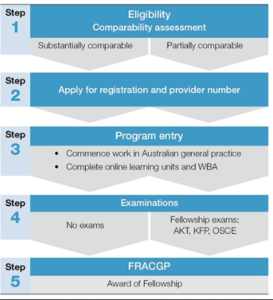
The outcome of the comparability assessment will determine your eligibility for entry and also which stream (Substantially comparable or Partially Comparable) you can undertake. In this blog we’ll focus specifically on your Substantially comparable  stream journey, from the day you start working in your approved practice to the day you attain Fellowship of the Royal Australian College of General Practitioners (FRACGP).

Supervision and Membership Requirements

Throughout the program, you must:
        •       Work under supervision.
        •       Maintain your Australian Health Practitioner Regulation Agency (AHPRA) medical registration.
        •       Remain a financial member of RACGP until you are admitted to Fellowship.
You will be well supported, your supervisor is a seasoned specialist GP approved by the MBA to provide supervision during your program. They play a crucial role in guiding you through your practice.
Upon starting the program, you will be assigned a Medical Educator (ME). MEs are RACGP staff members who are also experienced GPs with extensive educational and practical knowledge. They mentor and support your educational needs, ensuring you progress smoothly through the PEP SP. Regular meetings with your ME will be scheduled throughout your program.
During your induction, you will also get the opportunity to complete a practice workplace based assessment (a practice Clinical Case Analysis or CCA .  This will be used  later in the training program to  assess your competence against the standards set for a specialist GP at the point of admission to Fellowship.
During your training you must meet the below requirements:
  1. Supervised Practice
  2. Educational Activities
  3. Workplace-Based Assessments

These note a full list of requirements to be fulfilled before you can apply for Fellowship can be found here 

Supervised Practice

Before you start on the PC stream, RACGP will recommend the level of supervision you need while working in your approved practice. This recommendation will be based on your comparability assessment results and the context of your intended practice. Once you are 3 months into the program, you will sit with your supervisor and complete a Work Performance Report. This reviews performance criteria and highlights areas you have performed well in and areas for development.

Educational Activities

Educational activities include compulsory and optional tasks designed to ease your transition into Australian general practice.

Workplace Based Assessments

These help to assess your competence and include areas such as clinical information-gathering and interpretation,
making a diagnosis, decision-making and reasoning, clinical management and therapeutic reasoning. You will complete these while completing your training program.

WBAs comprise the following components: 

Multi-source feedbackUsed to collate feedback from colleagues and patients on your interpersonal and professional behaviour, development and clinical skills. 

Clinical assessment – Once you have settled and spent at least 3 months in your new practice, you will complete a clinical assessment via videoconferencing and be made up of two components: direct observations and clinical case analyses (CCAs).  The direct observations and CCAs will be conducted by three independent assessors, separate to your mentor ME. 

Once you have completed the WBAs you will be considered for entry of admission to Fellowship.

You can find further information here or if you would like to contact us please feel free to get in touch with our friendly team here

Considering Moving to Australia as a GP? Your FAQs Answered Here

If you’re a GP thinking about relocating to Australia, you may have many questions. This may be early stages of thinking or you might be ready to move and want to find out more.

Here we answer your most frequent questions regarding working as a GP in Australia

Where can I work? –  All overseas trained GPs are required to work in an areas which is Distribution Priority Area (DPA). This is in place for the first 10 years of your medical registration and you may hear it as your ’10 year moratorium.’

All the GP jobs on our website are suitable for you to apply. The areas where we find jobs are around Melbourne, Adelaide, Canberra, Brisbane, Tasmania, the Central Coast and regional cities such as Busselton, Broome and Rockhampton.  Check out the workforce locator map here to check the geographical classification of any location in Australia.

How long are the contracts? – Generally 2 years, some more rural practices may consider 12 months. 

What is the Expedited Specialist Pathway? – The expedited Specialist pathway is for specialist international medical graduates (SIMGs) with an international specialist medical qualification in General Practice. This offers a fast-tracked process, as you can apply directly to AHPRA  for specialist registration without having to undergo a separate specialist college assessment.

What is the Practice Experience Program (PEP) Specialist Stream? It provides a pathway for international medical graduates with overseas specialist qualifications to gain Fellowship with the RACGP. Please visit the PEP Specialist Stream webpage for more details.

Will I still get specialist registration? Yes, depends on which pathway you choose as to when. On PEP  once all Fellowship requirements have been met. On Expedited pathway you will receive it from registration.

What is WBA? – Workplace Based Assessment- completed approximately 6 months from commencing employment, provides a framework for evaluating performance and progress in practice. 

What’s does the PEP pathway to Fellowship look like? 

Do I need to sit exams on the PEP Pathway?

After satisfactorily completing all of the program requirements, substantially comparable participants will be eligible to apply for FRACGP. Partially comparable participants are eligible to enrol in the Fellowship exams after completing the WBA requirements.

If you are considering a move or just want to chat through options we have a dedicated team who will guide you through every step of the whole process. Visit our latest GP jobs or contact us directly for more information. 

How long does the paperwork take? – Depending on which pathway you take, we advise allowing around 6 months for Expedited Specialist Pathway and approximately 9 months from job acceptance to visa approval for PEP Specialist stream pathway.

Do I have to work under supervision? Yes for PEP Pathway, but just for 6 months if you’re substantially comparable. A period of self -reflection, peer review and clinical case analysis. There are no exams if you are substantially comparable.  The expedited Specialist Pathway also includes a six-month period of supervised practice, as well as an orientation covering Australian healthcare and cultural safety.

Will my earnings be affected during supervision? – No, in fact while completing the supervision period, you will have access to the full Medicare rebate (A1 rates) This means you bill the same as a vocationally recognised GP whilst working towards FRACGP.

Further Reading

RACGP 

Medical Board of Australia

DoctorConnect

Find out more about why Perth is so popular


The Australian Tax System for GPs Working in Australia

If you’re considering applying for GP jobs in Australia, you’ll certainly need to think about the financial aspects of moving to Australia. You might want to think about the cost of living in Australia as well as the Australian tax system and how it affects your take-home pay. If you own property in the UK and plan to keep it, you might also want to know how Australia taxes any income earned for overseas properties.

Average GP Salary Australia

Average GP salaries in Australia are excellent with most GPs earning between AUS $300,000 to $500,000+. Our GPs have a higher wage in Australia than they did in the UK.

GPs in Australia often earn a percentage of the billings rather than a fixed salary. This takes into account the number of patients they see, the complexity of the consultations and the number of hours worked. Our GPs have found that this payment system gives them more control over their take-home pay.

Paying Tax as a British GP Working in Australia

As a general practitioner,  we will help you relocate to Australia initially on a Temporary Skilled Shortage Visa (TSS 482). You will be classed as an Australian resident for tax purposes. 

Australian residents must declare any income earned from anywhere in the world. However, can also take advantage of Australia’s tax-free threshold and tax offsets. Australian residents also typically receive a lower tax rate than foreign residents.

Australia’s Tax System: How to Pay Tax

Before you begin working as a GP in Australia, you’ll need to apply for a tax file number, also known as TFN. The Australian financial year ends on June 30th and most people will need to file an annual tax return prior to this date. You’ll primarily be taxed on income and the amount you pay will depend on whether you’re an Australian or foreign resident.

Paying Tax in Australia as an Australian resident

Australia residents are entitled to claim a tax-free threshold of AUS$18,200 per year. This means you’ll only be taxed on income over the minimum threshold. You’ll also need to pay the Medicare levy, roughly 2% of your income, which helps support the country’s healthcare. In general, Australian residents using a TFN typically pay lower tax rates than foreign residents.

If you’re an Australian resident but only have a temporary resident visa, generally you won’t pay tax on any foreign income. Find out more

Paying Tax in Australia on Offshore Bank Accounts

If you decide to keep your UK bank account, you’ll need to report any interest or other income earned in your Australian tax income. Failing to declare this information could lead to financial penalties.

Working as a GP in Australia

Once you’ve secured a work visa and arrived in Australia, you need to apply for a TFN and complete a tax file number declaration. 

You must provide the declaration to your employer within 28 days of starting your GP job or you’ll need to pay the higher tax rate. After completing this initial paperwork, your employer will deduct taxes and submit them to the government.

We will help you get set up with all the relevant paperwork when you arrive.

Returning to the UK

While most of our GPs choose to make Australia their home for life, some decide to return to the UK. When you leave Australia, you’ll still need to submit a tax return. If you’re departing before the end of the tax year and don’t plan to return, you can lodge an Australian tax return early.

Ready to Move to Australia?

View our excellent GP job vacancies located throughout Australia or speak to one of our specialist recruitment professionals. Transition Medical is here to support you throughout every stage of your move from finding outstanding opportunities, securing Australian work visas and getting settled in your new home. Read our testimonies to learn about other GPs that we’ve helped make the move.

Other Relevant Blogs


Navigating the RACGP PEP Process

A Comprehensive Guide for GPs relocating to Australia

Embarking on a career as a General Practitioner (GP) in Australia is a rewarding journey, but it requires a thorough understanding of the qualifications and processes involved.

This is where Transition Medical come in. We are experts in providing critical advices and assistance in processing GP’s applications to a successful outcome. We provide our help at no charge to you!

About the PEP Program

The Royal Australian College of General Practitioners (RACGP) offers the Practice Experience Program (PEP) for international medical graduates (IMGs) seeking recognition as a GP in Australia. In this blog, we will delve into the RACGP PEP process, providing you with valuable insights into the steps, challenges, and opportunities that lie ahead.

Understanding the RACGP PEP:

 The RACGP PEP is designed for Specialist GPs who hold a recognised medical degree and a comparable GP qualification.

The program aims to assess and develop the necessary skills and knowledge required for practice in the Australian healthcare system.

Key Steps in the PEP Process:

  • Comparability Assessment
  • Job Approval Check
  • Medicare Provider Number Application
  • Work Based Assessment
  • Awarded Fellowship

Which Documents Do You Need?

The RACGP process is a comprehensive process and best completed with Transition Medical’s guidance. Here are examples of what is required:

  • Medical degree, GP certificates, identity documents
  • Evidence of 50 hours CPD in the last 12 months
  • 10 Completed Clinical case studies
  • Letters of support from your recent GP practices

At first glance it may seem quite a lot of paperwork however we break this down for you and following our instructions, it will be completed with minimal inconvenience.

Transition Medical have completed over 40 RACGP successful PEP applications.

How Long does it Take?

The PEP program takes in total around 24 weeks. The medical registration and visa pathway to work in Australia will take approximately 9 months and we suggest getting in touch 12 months before you want to be in Australia.

Conclusion

The RACGP PEP process is a comprehensive and rigorous pathway for international medical graduates aspiring to become General Practitioners in Australia. While it presents its share of challenges, successful completion opens doors to a fulfilling career in General Practice in Australia.

Transition Medical will guide you through the application and make it as smooth as possible to allow you to focus on the excitement of your relocation journey.

Further Reading

Australia GP Salary

Living in Perth, Australia


Australian Doctor Visa questions answered

Australia Doctor Visa Temporary and PR Visa Options Explained

An important question and consideration when you’re planning to move abroad is which Australia Doctor visa to apply for and if you are planning a permanent move, which PR option is right for you.

Our immigration advisers have put together some information below to help guide you. Please do get in touch to discuss your specific circumstances.

What are my GP Visa options?

As a General Practitioner (GP) you are eligible to move to Australia on either a temporary visa or on a permanent basis as your occupation is currently on the Long-term Strategic Skills List (MLTSSL). Common to all pathways is the requirement that applicants meet the Skill, Health and Character requirements. In the case of GPs, the Skill requirement is evidenced by successful registration with the Australian Health Practitioner Regulation Agency (AHPRA). To be able to hold AHPRA registration, you first need to have signed an agreement with a practice in Australia and completed your RACGP PEP comparability assessment.

Permanent Residency Applications

There are several visa pathways to achieving the objective of Permanent Residency (PR). In this short article, we’ll be explaining the pathways in a straightforward way to help you choose the most appropriate option.

In simple terms, there are 2 primary pathways to Permanent Residency which we’ll discuss today. The Skilled Independent visa (sub class 189) which is a points-tested stream and the Employer Sponsored pathway (subclass 186).

The Temporary Resident Visa (Temporary Skill Shortage Visa Subclass 482) 

This is the most common visa to relocate to Australia as a GP. This 482 visa can be granted for up to 4 years.

From a practical perspective GPs can enter Australia much faster by applying for the 482, rather than by applying from the UK for the permanent visa (186). At the time of writing, 90% of applications are assessed in 11 weeks. Current GPs going through the process, we see visa approval in as little as 6 – 8 weeks.

Under the 482-visa, as a GP you can either be employed on a full-time employment contract or you can be an independent sub-contractor and provide your services to the employer on an hourly / weekly pay rate or profit share arrangement. The majority of our GP Jobs are independent contractor agreements offering a percentage of weekly billings.

The 482 visa provides temporary residency status. As the holder of a 482 visa you are free to travel to and from Australia, your family can accompany you and your spouse is free to work or study without restriction. If you have been living in the UK prior to your move, you will be entitled to Medicare health services once enrolled. Until this time when you arrive in Australia, you will need to hold Private health cover.

Direct Entry Pathway (186 Visa only)

This visa allows skilled workers, who are nominated by their employer, work and live in Australia permanently. At time of writing, he processing time for 90% of visas is 54 weeks. Our Immigration Advisor suggests that it may be around 6 months for a UK doctor to gain approval. A recent UK trained GP had her 186 visa approval in 10 weeks.

Many of our GP practices are happy to provide this sponsorship to allow you to work in Australia on a permanent basis. You should be under 45 to apply for this visa, however there are exemptions to this if you meet this if you have previously held a 482 visa, have been working for the nominating employer for the previous 3 years and can meet the income threshold.

Skilled Independent visa (subclass 189)

This is a points-based option for skilled workers. For this application, you need to submit an expression of interest. The eligibility criteria area; you must have a relevant occupation and complete a suitable skills assessment for this. The Skill requirement will again be evidenced by successful registration with the Australian Health Practitioner Regulation Agency (AHPRA).

You will be required to meet the points test pass mark of 65 and be under 45 years old at the time you are invited to apply. In order to gain enough points, most GPs are required to sit an IELTS English language test.

Further Reading:

PR 189 Skilled Independent Visa

PR 186 Employer Sponsored Visa

For further information or to discuss your circumstances directly please get in touch with one of the team here at Transition Medical. Richard, our Specialist Immigration Advisor and Lawyer is on hand to help.

Further Reading on our blog

Australian Education system

Find out more about working as a GP in Australia

Benefits of working as a GP in Australia