Australia’s GP Shortage: Patient numbers

Australia’s GP Shortage: The 2026 Reality Check

Australia’s General Practitioner  shortage remains a major issue in 2026. Despite significant government investment, expanded training pathways, and continued international recruitment, demand for GPs still exceeds supply,  particularly in regional, rural, and outer-metropolitan communities.

The Federal Government has announced more than $1 billion in GP workforce funding, with around 2,100 doctors expected to commence GP training in 2026, the largest intake on record. Additional training places have also been created for 2027. These are positive steps, but they will take years to translate into fully qualified GPs working independently in communities that need them most. (www.health.gov.uk)

At the same time, the Department of Health’s own modelling continues to project an ongoing shortfall of GPs over the next two decades unless further action is taken. In short: more doctors are entering the pipeline, but demand is growing faster than supply. (www.oia.pmc.gov.au)

The shortage also remains unevenly distributed. Australia doesn’t just have a workforce shortage — it has a workforce distribution problem. Many inner-city areas remain relatively well serviced, while rural towns, remote communities, and fast-growing outer suburbs continue to struggle to attract and retain doctors. This is why the Distribution Priority Area (DPA) system remains central to workforce planning and IMG recruitment. (www.health.gov.au)

For patients, this often means longer wait times, reduced continuity of care, and increasing pressure on emergency departments for issues that should be managed in primary care.

Why Demand Keeps Growing?

One of the key drivers of rising demand is the increasing prevalence of chronic disease and an aging population. Between 2023 and 2048, even small percentage increases in major health conditions will result in hundreds of thousands of additional patients requiring ongoing GP care. The GP Supply and Demand Study (2024) projects a consistent undersupply of GPs through to 2048, with unmet demand rising across all states and territories

Several factors contribute to this persistent shortfall. More GPs are retiring than entering the profession, and many are choosing to work fewer hours. Workforce demographics are shifting, with overseas-trained doctors (IMGs) typically working longer hours, while a growing number of female GPs opt for more flexible schedules. Training bottlenecks also continue to limit the number of new registrars completing the pathway.

Overseas-trained doctors remain vital to maintaining access to primary care across Australia. Pathways such as the AHPRA Expedited Specialist Pathway, RACGP’s PEP Specialist Stream, and Distribution Priority Areas (DPAs) allow IMGs to work in shortage zones under special conditions, helping to fill critical gaps in the system.

How New GPs Can Build a Busy, Sustainable Practice

For new GPs entering the workforce, the ongoing shortage presents a unique opportunity. With strong demand almost everywhere, building a busy, sustainable practice is achievable with the right approach. Success often hinges on being available, building connections and trust.  Getting to know the local community is essential. Participating in events, collaborating with pharmacists, allied health providers, and schools can help build relationships and generate word-of-mouth referrals — still the most powerful growth tool for GPs. Offering a diverse mix of services, such as chronic disease management, mental health care, skin checks, and minor procedures, also helps attract and retain patients.

Technology plays a key role in being found. Online booking systems, telehealth options, and active profiles on platforms like Google and Healthengine make it easier for patients to discover and choose a GP.  Working as part of a well-organised team, including nurses, receptionists, and other clinicians — supports efficient, patient-centred care. Practices that prioritise continuity, accessibility, and consistent follow-ups tend to grow faster and retain patients more effectively.

For GPs considering a move to Australia, asking the right questions during interviews is crucial. Practice models and billing arrangements vary widely, and understanding patient flow,  and financial structures can make the difference between a full schedule and a slow start. It’s worth researching the practice online, checking their website, social media presence, and HotDoc listings, to see how they present themselves and how easy they are for patients to find.

During interviews, think about what you might want to ask to gauge how busy the practice is, what the average weekly billings per GP, typical session structures, and patient demographics. Find out whether the practice maintains a registered patient list or operates on open access, and ask about waiting lists or unmet demand. Clarify how sessional hours and payments are structured  and what the practice does to attract new patients.

Conclusion

Australia’s GP shortage isn’t going away anytime soon. While headcounts are rising, full-time capacity is falling, and chronic disease, population growth, and retirements continue to outpace recruitment. But for new GPs, this shortage represents opportunity. Those who combine strong clinical skills with community engagement, digital visibility, and patient-centred care will find themselves in high demand. Do your research and ask questions,  it’s the best way to set yourself up for success in Australian general practice.

Further Reading

Top 10 Tips for GPs relocating to Australia

Bulk Billing Incentives in Nov 2025

References

Australian Government Department of Health, Disability and Ageing – General Practice Workforce Providing Primary Care Services in Australia, 2019–2024
GP Supply and Demand Study Compendium, August 2024 – hwd.health.gov.au

Talking with a UK Trained Rural GP working in rural Australia

Transition Medical were contacted by a rural farmer and local community member to assist the rural town of Wudinna to find a GP. The community of 600 people had been without a doctor for almost 2 years. Patients were having to either drive 2 hours to the nearest GP or fly to Adelaide for treatment.

Dr Ernest Wong, a newly qualified UK trained GP signed up for this amazing experience of being the only rural GP doctor in the town. Ernest started work in October 2023 and has put together this wonderful picture of life as a rural GP in Australia. We loved working with Ernest and the team at Wudinna and his placement there has made such a huge difference to the local community.

Happy Reading! Emma Cook, MD Transition Medical.

Dr Scott Lewis, my GP supervisor, flew me out in his plane to the tiny town of 600 people. This was our third flight together and he still hasn’t told me where the parachutes are. I tried not to think too much about that, instead focusing on the excitement of things to come.

Dr Ernest Wong and his Supervisor

I was going to be the new and only doctor in a grain and cattle farming community in a district which covered an area five times the size of London. Besides being the GP for the community, the role also includes providing cover for the local A&E (2 trolleys), acute hospital (8 beds) and nursing home (10 beds).

Wudinna Hospital – If you need a CT scan? The nearest one is 200 km (125 miles) away!

Having arrived in summertime (harvest season), the days are hot and the nights cool. The climate is a hot mediterranean climate that reminded me of Spain.

Not-so-subtle signs that this is a farming community.

Just as we got to the hospital, a paramedic was transporting an elderly patient to the air ambulance (Royal Australian Flying Doctors). I wasn’t expecting Scott to say; “Oh by the way, she (paramedic) is the mayor”. Turns out all the paramedics in town are volunteers! Such is the realities of rural life – everyone must pull together to survive.


The mayor is also a part-time columnist.

In my first clinic I was confronted by my biggest challenge yet – a manual blood pressure cuff – which I had not touched in years as a doctor in England. The rest of my day was mostly bread-and-butter GP stuff – minor illness and injuries, chronic disease management, repeat prescriptions and driving license medicals – all whilst grappling with IT, Medicare billing and a gazillion drug brand names (unlike the UK, it is not mandatory to prescribe in generics).

Strangely, the work felt a lot more relaxed compared to the NHS. The tempo is much lower, there is more autonomy and patients are extremely understanding. I have been called away to emergencies several times to return to find that patients have been rescheduled, so I almost never miss lunch or leave the clinic after 5.30 pm.

Providing on-call cover for the hospital was terrifying initially but one gains confidence after a few weeks of support “just a phone call away”. Consultants in various specialities are available 24/7 for video advice and guidance. It also helps that the nurses are local and have a deep understanding of the local community.


Nothing says “straya” like spiders!

People here are tough as nails. I saw a 92-year-old man with terminal lung cancer walking into my consulting room unaided without breaking a sweat. He wanted a repeat prescription. Probably fitter than most of my 50-year-old patients in England, I thought. On the flip side, if a stoic farmer presents to A&E during harvest season, best to drop everything and attend to him as it might be something catastrophic.

The community has been welcoming, having provided me with a car and furnished house, complete with a vegetable garden planted ahead of my arrival! I have also received freshly caught fish and baked goodies from at least 4 people so far, and invitations to various social gatherings. It feels refreshing to be looking after a community who are clearly appreciative of my efforts.


I was part of a children’s school project, apparently.

Overall, I am glad to have made the Transition down under, one which would not have been possible without the tireless efforts of Emma and Kirsty at Transition Medical – from their putting me in touch with the right people to their help with jumping through the numerous regulatory hurdles.

For more information on how you can live an adventure in Australia, please do get in touch or see our GP Jobs Page for further information.

Geelong: Coastal living, Melbourne on your doorstep, and a better work-life balance for GPs

A growing coastal city offering strong GP demand, family living and easy access to Melbourne.

For many UK and European GPs considering Australia, the usual shortlist includes Sydney, Melbourne, Brisbane or Perth.

But increasingly, smart movers are looking just outside the major capitals, to places that offer lifestyle, affordability, career opportunity, and access to world-class cities without the daily stress.

That’s exactly where Geelong comes in.

Located just over an hour from Melbourne, Geelong is Victoria’s second-largest city and one of Australia’s fastest-growing regions. It offers a rare combination of coastal lifestyle, family-friendly living, excellent schooling, and strong demand for doctors.

For UK and European GPs relocating to Australia, Geelong is becoming one of the most attractive options on the map.

A Real City Without the Pressure of a Major Capital

One of Geelong’s biggest attractions is that it feels like a proper city in its own right. It has a thriving CBD, excellent cafés and restaurants, major retail centres, sporting facilities, universities and a growing healthcare network.

Yet unlike larger capitals, daily life is significantly easier. Traffic is lighter, commuting times are shorter, parking is simpler, and the overall atmosphere is more relaxed. For many doctors arriving from the UK, where long commutes and high living costs are common frustrations, this can feel like an immediate lifestyle upgrade.

You still have access to everything you need, but without the stress that often comes with living in a major metropolitan centre.

Melbourne Is Close Whenever You Need It

Another major advantage of Geelong is proximity to Melbourne. The city is close enough that residents can easily travel in for work meetings, major sporting events, concerts, shopping or international travel, then return home the same day.

This creates an ideal balance. You can enjoy the energy and opportunities of one of the world’s great cities, while building your day-to-day life somewhere calmer, more spacious and more affordable.

For many relocating GPs, it offers the best of both worlds.

The Coastal Lifestyle People Move to Australia For

Lifestyle is often one of the biggest motivations for doctors moving abroad, and Geelong delivers in abundance.

Situated on Corio Bay and acting as the gateway to the Bellarine Peninsula and Great Ocean Road, Geelong offers easy access to beaches, ocean walks, wineries and some of Victoria’s most scenic landscapes.

Weekends can mean breakfast by the waterfront, trips to the beach with the family, surfing, cycling, hiking or exploring nearby coastal towns. It is the kind of outdoor lifestyle many UK and European doctors picture when they first think about moving to Australia.

In Geelong, it becomes part of normal life.

An Excellent Choice for Families

Geelong is also particularly attractive for GPs relocating with children.

The region is known for its strong mix of public and private schools, family-friendly suburbs, sporting culture and community atmosphere. Housing tends to offer more space than equivalent homes in Melbourne, often with larger gardens and access to parks, playgrounds and outdoor facilities.

For families moving from crowded urban areas in the UK or Europe, Geelong can provide the breathing room they have been looking for.

It is a place where children can enjoy an active outdoor upbringing while parents benefit from a more balanced pace of life.

Strong Career Opportunities for GPs

Alongside lifestyle benefits, Geelong also offers excellent professional opportunities.

The city’s rapid population growth continues to drive demand for healthcare services, particularly within general practice. Established clinics across Geelong and surrounding suburbs are often seeking doctors to meet patient demand, creating attractive openings for incoming GPs.

Depending on the clinic, opportunities may include mixed billing or private billing models, flexible schedules, women’s health, chronic disease management, mental health, skin medicine and family medicine.

For many overseas-trained doctors, Geelong can offer busy patient books, strong earning potential and long-term career stability.

Well Connected for Travel Home

For UK and European doctors, staying connected to family matters.

Geelong benefits from access to both Avalon Airport and Melbourne Airport, making domestic and international travel straightforward. Whether visiting family back home or welcoming visitors to Australia, transport links are convenient and practical.

That reassurance can make a major difference when planning a move abroad.

Why More GPs Are Looking at Geelong

Geelong offers something many doctors struggle to find in one destination. It combines career opportunity with lifestyle, affordability with convenience, and family living with access to a world-class city.

You can enjoy coastal Australia, build a rewarding GP career, give your family more space, and still have Melbourne on your doorstep.

For many UK and European GPs, that combination is hard to ignore.

Thinking About Australia?

If you are considering relocating, Geelong deserves serious attention.

At Transition Medical, we help UK and European GPs secure high-quality roles across Geelong, Victoria and wider Australia, with support on registration, visas, contracts and relocation.

Get in touch today to explore current Geelong opportunities.

GP Jobs Available now!

GP Job Geelong- 70% Billings

Bulk Billing is Back (…and It’s Worth a Second Look)

Why UK & European GPs Should Reconsider Bulk Billing in Australia

For years, bulk billing in Australia has been seen as something to move away from. Many practices shifted toward mixed or private billing models as costs rose and Medicare rebates struggled to keep pace.

But over the past 12–18 months, something has quietly changed. And for GPs looking to relocate from the UK and Europe, it’s a shift worth paying attention to.

What Has Changed?

In November 2023, the Australian Government introduced a significant expansion of bulk billing incentives, including tripling the incentive for children, pensioners and concession card holders.

This increased payments from roughly $6–$7 per consult to over $20 in many cases, with even higher incentives in regional areas. Combined with resumed Medicare indexation, this has made bulk billing financially viable again for many practices.

The Numbers Behind the Shift

Bulk billing rates, which had dropped below 70% nationally, are now stabilising and in some regions returning toward 75–80%.

We are seeing practices that had moved to predominantly private billing (70–80%) shifting back toward 60–80% bulk billing activity, particularly in high-demand suburban areas.

Why This Works for GPs

Bulk billing clinics that are well run are built for efficiency. They offer strong patient demand, structured workflows, and excellent support systems.

This means full appointment books, minimal downtime, and a predictable working day. Rather than relying on higher fees, earnings are driven by consistency and throughput.

Earning Potential

With typical billing splits of 65–75%, many GPs working in high-performing bulk billing clinics are earning between AUD $350,000 and $500,000+, with some exceeding this range.

The key difference is consistency. Full books from day one remove the uncertainty often seen in mixed billing environments.

Why It Suits UK & European GPs

For GPs coming from the NHS or similar systems, bulk billing offers a smoother transition. There is immediate patient demand, reduced administrative burden, and far greater operational support.

Instead of balancing clinical work with the pressures of running a practice, GPs can focus on medicine in an environment designed for efficiency.

Final Thought

Bulk billing is no longer the lesser option. It has evolved into a scalable, sustainable model that offers strong earnings, stability, and a clear pathway for GPs relocating to Australia.

Thinking About Making the Move?

At Transition Medical, we work with a range of practices across Australia, including some exceptionally well-run bulk billing clinics.

If you’d like a clearer picture of how this works in real terms, we’re always happy to talk it through. No pressure, just honest insight.

Further Reading

Australia’s Game-Changing Reforms to Bulk Billing

GP Job Gold Coast- High Earning Bulk Billing

Why Australasia Is an Increasingly Attractive Option for Doctors Right Now

A Stable Environment in a Changing World

As global uncertainty continues to influence both personal and professional decisions, many UK and European-based GPs and hospital consultants are taking the opportunity to reassess where they want to live and work.

Australia and New Zealand are increasingly coming into focus. Not just for the career opportunities available, but for the stability, lifestyle and overall balance they can offer.

With ongoing geopolitical and economic uncertainty in parts of the world, stability and security are becoming more important considerations. Australia and New Zealand are widely regarded as well-governed countries with high standards of living, and for many doctors and their families, that sense of distance from global unrest provides reassurance when thinking about the future.

At the same time, ongoing pressures within the UK system have led some doctors to explore alternatives. It’s not about one being better than the other, but about what feels right for you and your family at this stage.

Strong Demand and Real Opportunities

Alongside lifestyle considerations, there is also a clear practical reality.

Both Australia and New Zealand continue to experience strong demand for GPs and hospital consultants, particularly in regional and community-focused settings. For UK and European doctors, this creates genuine opportunities to step into well-supported roles where their experience is recognised and valued from day one.

The process of relocating is also more straightforward than many expect. With expedited pathways and a range of visa options, there are now clearer routes to registration. Qualifications are widely recognised, and with the right guidance, the process can feel structured rather than overwhelming.

Check your eligibility here

For many, the biggest shift is simply understanding that the move is not only possible, but far more achievable than they first thought.

A More Balanced Way of Working

For many doctors, the decision to move isn’t just about career progression. It’s about finding a better balance.

Compared to the pressures often experienced within the NHS, roles in Australia and New Zealand can feel more manageable day-to-day. Patient demand remains high, but workloads are often more structured, with greater autonomy and more predictable working hours.

That shift doesn’t just affect your working week. It changes what life looks like outside of work too. More time with family, more opportunity to get outdoors, and a greater ability to properly switch off.

A Lifestyle That Works for Families

For those considering a move with family, lifestyle becomes an even more important part of the decision.

Australia and New Zealand are known for being safe, welcoming places to live, with strong schooling options and well-established communities. It’s the kind of environment where families can settle in comfortably and build a longer-term future.

One of the most consistent pieces of feedback we hear from doctors who have made the move is how much more time they feel they have. Time with their children, time outdoors, and time to enjoy where they live.

Listen to Ciara’s experience here

Is Now the Right Time?

Relocating abroad is a significant decision, but one that many doctors are now actively considering earlier than they might have done previously.

Australia and New Zealand offer a compelling combination of stability, lifestyle and financial opportunity. For those beginning to explore their options, there has never been a clearer or more supported pathway to making it happen.

Speak to Transition Medical

At Transition Medical, we’ve been helping GPs and hospital consultants move to Australia and New Zealand for over a decade.

We guide you through every stage of the process — from initial conversations through to registration, visas and starting in practice — making what can feel complex much more straightforward.

Get in touch here

If you’d value a conversation about how this could work for you, we’re always happy to talk things through.

Further Reading

GP Clinics Models in Australia for GPs

Why Hospital Consultants are considering NZ 

GP Salary Australia – GP Earnings in 2026

A Visual Timeline for Moving to New Zealand as a GP 

Overview: The GP Registration Process in New Zealand

New Zealand continues to be one of the most attractive destinations for UK trained GPs, offering an excellent work-life balance, high demand for doctors, and a straightforward registration process.

If you’re considering making the move, one of the most common questions is: how long does it actually take?

The good news is that the process is relatively efficient, and in many cases, GPs can relocate within 3-6 months when steps are managed in parallel.

To work as a GP in New Zealand, you must be registered with the Medical Council of New Zealand (MCNZ).

For UK doctors, the process is typically streamlined, and most applicants are not required to sit additional exams, provided they meet the eligibility criteria.

There are two main pathways for provisional general registration:

Competent Authority Pathway

The Medical Council recognises the Irish Medical Council and the UK’s General Medical Council as competent authorities. This is the most commonly used pathway for medical registration for GPs in the UK to apply. To apply you must hold a primary medical degree from a university medical school in the UK or Ireland, have completed your internship in the UK or Ireland and meet the fitness to practice requirements.

Comparable Health Pathway

You can apply for this pathway if you have a primary medical degree from a university medical school listed in the World Directory of Medical Schools (see here); have worked in a comparable health system(s) for a minimum of 30 hours per week for at least 33 of the last 48 months; have proposed employment in New Zealand in the same or similar area of medicine, at a similar level of responsibility to the work you have done in the last 48 months, and hold a full or general registration in at least one comparable health system which contributes to this time in clinical practice.

If English is not your first language you may first need to sit and pass International English Language tests. Transitional Medical will be able to guide based on your individual circumstances.

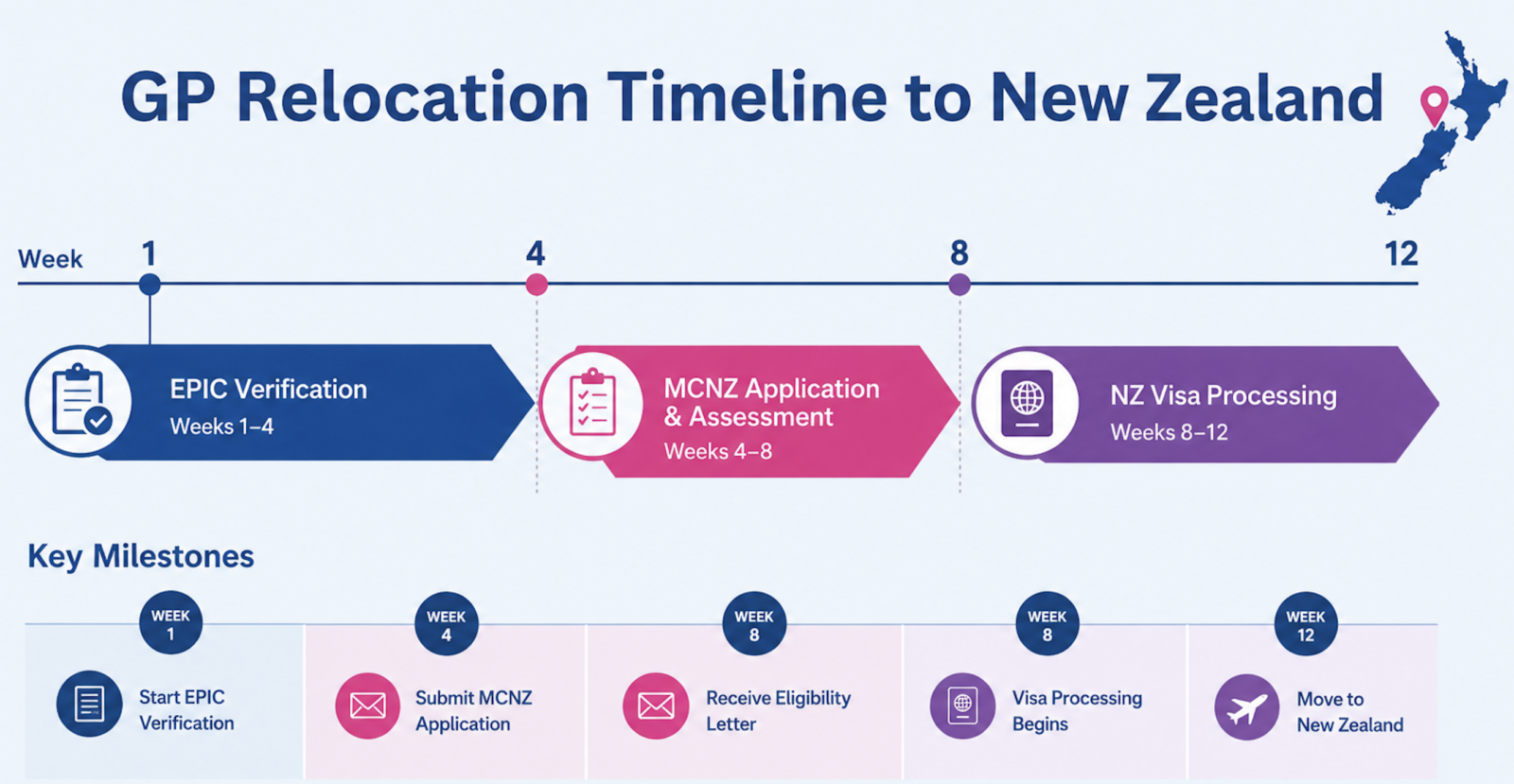
The Timeline: How Long Does It Take?

While individual timelines vary, these stages can often overlap, which significantly reduces the total time.

  • Primary Source Verification (EPIC / MyIntealth)
  • MCNZ Application & Assessment
  • Visa Processing

Visual Timeline

Primary Source Verification

Before applying for registration, your qualifications must be verified through EPIC/MyIntealth.

MCNZ Application

Once verification is underway, you can submit your application to MCNZ. Processing typically takes 4-6  weeks, depending on,  completeness of documentation and whether additional information is requested.

Once your medical registration is approved in principal, successful, you’ll receive an invitation to attend a registration interview in New Zealand to finalise your application.

Visa Application

After receiving approval in principal, you can apply for your visa.  Most GPs apply for an Accredited Employer Work Visa (AEWV).

Arrival & Registration Interview

Once you arrive in New Zealand, you’ll attend a registration interview to:

  • Confirm your documentation
  • Finalise registration
  • Apply for your practising certificate

After this, you are officially able to begin work.

Conclusion

Relocating to New Zealand as a GP is a structured and achievable process, particularly for UK-trained doctors.

If you’re considering the move and want tailored guidance on your eligibility, timeline, or job opportunities, working with a specialist medical recruitment team can make the process significantly smoother.

Further Reading

Your guide to shipping your belongings to NZ 

What are the costs involved in relocating to NZ? 

Corporate Vs Independent GP Clinics: What you should know

Why UK Hospital Consultants Are Considering a Move to New Zealand

Why UK Hospital Consultants Are Considering A Move To New Zealand

For many UK hospital consultants, the idea of working overseas is becoming increasingly attractive. In recent years, New Zealand has emerged as one of the most popular destinations for experienced doctors seeking a change in lifestyle while continuing to practise high-quality medicine.

With its strong healthcare system, welcoming communities, and renowned work-life balance, New Zealand offers opportunities that appeal to consultants across a wide range of specialties.

A Healthcare System That Values Experience

New Zealand’s public healthcare system relies heavily on experienced senior doctors to deliver specialist care across its hospitals. As a result, there is ongoing demand for international consultants who can bring expertise, leadership, and clinical excellence to local teams.

UK-trained consultants are particularly well regarded due to similarities in training pathways and clinical standards. Many hospitals actively recruit from the UK, making the transition relatively smooth compared to relocating to other parts of the world.

A Better Work-Life Balance

One of the most commonly cited reasons consultants move to New Zealand is the improved work-life balance. While medicine everywhere can be demanding, many doctors report a more sustainable pace of work, allowing greater time for family, travel, and personal interests.

New Zealand’s lifestyle is also a major draw. From coastal cities to dramatic mountains and national parks, the country offers endless opportunities for outdoor activities such as hiking, cycling, skiing, and water sports.

Salary & Benefits

Consultants are employed under the ASMS Collective Agreement, On-call is not included in the salary which means any on-call income will be in addition to your annual salary. Benefits packages are very competitive, including the below examples:

  • Generous annual leave
  • Continuing Medical Education (CME) allowance
  • Professional development support
  • Relocation assistance for international candidates
  • KiwiSaver (Pension allowance)

Professional Opportunities and Career Development

Consultant roles in New Zealand often provide a broad scope of practice, with opportunities to contribute to service development, teaching, and research. In smaller regional centres especially, consultants may have the chance to take on leadership roles and shape the future of healthcare delivery within their specialty.

For doctors interested in developing new services or expanding their clinical portfolio, these roles can be professionally rewarding.

Support With the Relocation Process

Moving countries is a significant decision, and navigating licensing, visas, and relocation logistics can feel complex. Working with a specialist medical recruitment partner can help simplify the process.

Recruitment teams experienced in international placements can guide consultants through each stage, including:

  • Identifying suitable consultant opportunities

  • Navigating medical registration requirements

  • Understanding visa pathways

  • Preparing for interviews

  • Coordinating relocation timelines

Is New Zealand the Right Move for You?

Relocating overseas isn’t the right choice for everyone, but for many UK consultants it offers the chance to combine a fulfilling medical career with a high quality of life.

If you’re exploring international opportunities, New Zealand is certainly worth considering.

At Transition Medical, we work with experienced hospital consultants who are interested in learning more about roles in New Zealand and other international healthcare systems. Our team provides guidance throughout the process so you can make an informed decision about your next career step.

Why Canberra Is A Great Place For GPs Moving To Australia

Canberra, Australia’s capital city is quickly becoming one of the most attractive destinations for General Practitioners.

Located in the Australian Capital Territory and home to just over 450,000 people, Canberra offers a unique combination of career growth, family-friendly living, and cultural richness that is hard to match anywhere else in Australia.

A Young, Growing Population Creating High Demand for GPs

Canberra has one of the youngest and fastest-growing populations in Australia, with many professionals and young families choosing the city for its lifestyle and career opportunities.

This growing population means consistent demand for high-quality primary care, making Canberra an excellent place for GPs who want to:

  • Build a loyal patient base quickly
  • Work in modern, well-supported clinics
  • Develop long-term patient relationships
  • Explore opportunities for partnership or practice ownership
  • For doctors who enjoy being part of a community and making a real impact in patients’ lives, Canberra provides the perfect environment.

Excellent Schools and Family-Friendly Living

For doctors relocating with families, Canberra is widely considered one of the best cities in Australia for education and raising children.

The city offers a range of highly regarded public and private schools, as well as access to top universities including Australian National University and University of Canberra.

Families benefit from safe neighbourhoods, excellent public schooling options, extensive parks and green spaces, and short commute times, often under 25 minutes, leading many doctors relocating from the UK to find that life in Canberra offers a higher quality of life for children than many larger cities

As Australia’s capital city, Canberra is home to some of the country’s most important cultural institutions, with an abundance of museums and national institutions.  These venues regularly host exhibitions, cultural events, and festivals, creating a vibrant arts scene that many new arrivals are pleasantly surprised by.

Outdoor Lifestyle Without the Big-City Stress

Canberra is surrounded by beautiful natural landscapes, offering endless opportunities for outdoor activities and an active lifestyle. Doctors living in the city can enjoy hiking in nearby national parks, cycling around Lake Burley Griffin, taking weekend trips to the snowfields, or visiting the beaches along the South Coast of New South Wales.

This unique setting allows residents to enjoy the space and tranquillity of regional living while still benefiting from the infrastructure, amenities, and career opportunities of a capital city.

Strong GP Earnings and Partnership Opportunities

In Canberra, many practices offer:

  • High percentage billings
  • Flexible working hours
  • Excellent nursing and administrative support
  • Clear pathways to partnership or practice ownership
  • Because demand is strong, GPs often have the opportunity to shape their work schedule and develop areas of special interest.

Easy Access to Sydney and the Rest of Australia

Although Canberra offers a relaxed lifestyle, it is still well connected.

The city is just three hours by road from Sydney, making weekend visits easy. Canberra also has a growing international airport with connections across Australia. This makes it simple to enjoy the benefits of capital city living while still accessing Australia’s larger metropolitan centres.

Conclusion

For GPs relocating from the UK or Europe, Canberra represents something special, a city where professional opportunity and lifestyle truly meet. If you’re considering a move to Australia, Canberra may just be the perfect place to build both your medical career and your life.

Corporate vs Independent GP Clinics In Australia: What International Doctors Should Know

Thinking about GP jobs in Australia? Learn the differences between GP Models

For many doctors considering a move overseas, Australia consistently ranks as one of the most attractive destinations for general practitioners. A strong primary care system, high earning potential and excellent work-life balance make it a popular choice for international GPs.
One of the biggest differences compared with healthcare systems such as the NHS is how GP clinics are structured.
Broadly speaking, GP roles fall into three main categories:
  • Corporate medical centres
  • GP super clinics
  • GP-owned independent practices
Understanding how these clinic models operate can help doctors choose the working environment that best suits their professional and lifestyle priorities.

Corporate GP Clinics

Corporate clinics are large medical centres operated by national healthcare organisations that manage multiple practices across Australia.
These clinics provide the infrastructure, administration and management, allowing GPs to focus primarily on patient care.
For international doctors, corporate clinics are often the easiest entry point into the Australian healthcare system.
Benefits of Corporate Clinics for International GPs
One of the biggest advantages is that corporate organisations are well experienced in recruiting overseas doctors. As a result, they are more likely to offer structured relocation packages, which may include:
  • Visa sponsorship and migration support
  • Relocation allowances
  • Temporary accommodation
  • Initial income guarantees
  • Established patient lists
Many corporate clinics also offer large multidisciplinary medical centres, often including pathology, imaging, physiotherapy and pharmacy services within the same building.
This integrated model can make the transition to Australian practice smoother for doctors relocating from overseas.

Things to Consider

Because corporate clinics operate on a larger scale, they often have standardised systems and policies. While this can create efficiency and strong administrative support, it may also mean:
  • Less control over billing structures
  • Standard consultation times
  • Limited influence over clinic operations
For some GPs this structured environment is ideal, while others may prefer more autonomy.

GP Super Clinics

Another model you may encounter in Australia is the GP Super Clinic.
Super clinics are larger healthcare centres designed to provide multidisciplinary primary care services under one roof. These clinics were originally developed to improve access to healthcare, particularly in areas with growing populations or GP shortages.
Super clinics typically include:
  • Multiple GPs
  • Nursing teams
  • Allied health professionals
  • Diagnostic services
  • Training opportunities for GP registrars and medical students
For doctors interested in teaching or collaborative team-based care, this model can be appealing.
However, employment arrangements in super clinics often resemble those found in corporate medical centres, with more structured contracts and systems.

GP-Owned Independent Clinics

Independent GP clinics are owned and run by one or several general practitioners rather than large healthcare corporations.
These practices are often smaller and more community-focused, and they remain an important part of the Australian primary care landscape.

Greater Flexibility for Doctors

One of the key advantages of GP-owned clinics is flexibility.
Contracts in independent practices are often more negotiable, and GPs may have more control over their working arrangements. This can include:
  • Flexible working hours
  • Greater freedom when booking annual leave
  • Longer consultation times if preferred
  • Input into billing policies and practice decisions
Many GPs find that independent practices offer a more personalised working environment, with strong continuity of care and long-term relationships with patients.

Potential Limitations

Because these clinics are smaller businesses, they may not always have the same financial resources as large corporate organisations. As a result, relocation incentives such as visa support, accommodation or relocation allowances are less common, although some rural practices do still offer them to attract doctors.

Which Clinic Model Is Best for International GPs?

There is no single “best” clinic model. The right choice depends on your priorities as a doctor.
Many international doctors actually move between these models during their careers. It’s common to begin in a larger corporate clinic while settling into Australia, then transition into a smaller independent practice later.

Conclusion

Australia offers one of the most diverse and flexible general practice landscapes in the world.  We work with a wide network of practices across Australia, including corporate medical centres, super clinics and GP-owned independent practices. This means we can offer doctors a broad range of opportunities and help match you with the clinic model that best aligns with your priorities, whether that’s relocation support, flexibility or long-term career development.
If you’re considering GP jobs in Australia, speaking with a specialist recruiter can help you explore the different options available and find a role that fits both your professional goals and lifestyle plans.

Further Reading

Real Life Story: Helping UK GP relocate to Australia

GP Salary Australia: Find out what you can earn

What GPs Can And Can’t Claim At Tax Time In Australia

A Practical Guide to What You Can and Can’t Claim

Tax time can feel confusing, particularly if you’re new to working in Australia or adjusting to a different healthcare system. The rules around what you can and can’t claim aren’t always straightforward, and it’s easy to second guess yourself when lodging a return.

The good news is that many doctors are entitled to claim legitimate work-related expenses, as long as they meet the Australian Tax Office’s criteria and are properly recorded.

Below is a practical overview to help you understand what is generally claimable, what isn’t, and how to avoid common pitfalls.

The Basic Rule: What Makes an Expense Claimable?

In general, a work-related expense must meet all three of the following conditions:

  • It is directly related to your work

  • It has not been reimbursed by your employer

  • You have records (such as receipts or bank statements)

If an expense doesn’t meet all three, it usually can’t be claimed.

Common Expenses Doctors Can Often Claim

Working From Home

If you work from home, for example, completing clinical notes, administrative tasks, or telehealth, you may be able to claim a portion of your home running costs. The ATO allows two main methods for this. One is the fixed rate method, currently set at 70 cents per hour, which requires records of the hours you’ve worked from home. The other is the actual cost method, where you claim the work-related portion of expenses you’ve incurred.

Depending on the method used, claimable expenses may include things like the depreciation of home office furniture or electronic devices, electricity and gas used for lighting, heating or cooling, work-related phone and internet costs, stationery and computer consumables, and cleaning costs for a dedicated home office.

Education and Professional Development

Education and training costs are generally claimable if they relate directly to your current role and help you maintain or improve the skills you already use at work. This can include courses, seminars, conferences, and workshops that are relevant to your day-to-day practice.

However, you can’t usually claim study that helps you move into a new role, change careers, or gain a promotion. The key test is whether the education supports your current duties, rather than helping you transition into something new.

Motor Vehicle and Work-Related Travel

Travel that forms part of your work, such as visiting other clinics, hospitals, or attending meetings away from your usual workplace, may be deductible. If you use your own vehicle, you can either claim a set rate per kilometre (currently 88 cents per kilometre, up to 5,000km per year) or use the logbook method to claim actual running costs.

In addition, parking fees, tolls, and public transport used for work-related travel may also be deductible.

If your role requires you to stay away from home overnight, you may be able to claim accommodation, meals, and incidental expenses, provided your employer hasn’t already reimbursed you. In some cases, the ATO’s reasonable travel allowance limits apply, which can reduce the need for detailed receipts.

Work Related Clothing

Certain types of clothing can be claimed if they are directly related to your role. This typically includes uniforms with a business logo, as well as protective items such as safety equipment, sunglasses, or sunscreen. Laundry costs associated with maintaining these items may also be deductible.

Professional Fees and Memberships

Doctors can usually claim professional expenses that are directly tied to their current role. This may include medical registration and licence renewals, professional memberships or subscriptions, and union fees where applicable. As with all deductions, these costs must not have been reimbursed by your employer.

What You Can’t Claim

Some expenses often cause confusion but aren’t deductible under ATO rules.

Commuting

Travel between your home and your usual place of work is considered a private expense, even if the commute is long, you work part-time, or you only attend the workplace occasionally. The main exception is if you’re required to carry bulky equipment that can’t be stored securely at work.

Everyday Clothing

Everyday clothing isn’t claimable, even if you only wear it at work. This includes business suits, plain scrubs, and standard clothing worn by healthcare or retail staff. Unless the clothing is a uniform or protective item, it’s considered a private expense.

Personal Expenses

Personal costs such as hair and grooming, childcare, and private medical expenses aren’t deductible, even if they feel indirectly related to your ability to work.

Record Keeping: Make Life Easier Later

Keeping good records throughout the year can make tax time far less stressful. This includes holding onto receipts or invoices, maintaining a logbook for work-related vehicle use, and keeping diaries, rosters, or timesheets to support work-from-home claims. Digital tools such as the ATO’s MyDeductions app or receipt-tracking apps can help keep everything organised.

For official and up-to-date guidance, it’s always best to check the Australian Taxation Office website.

Common Tax-Time Mistakes to Avoid

One common mistake is not claiming what you’re entitled to. If an expense is genuinely work-related and you have the evidence, it’s reasonable to include it. A registered tax agent can help if you’re unsure.

Another issue is over-claiming or exaggerating deductions. The ATO compares claims across similar professions, and unusual claims may be flagged. Incorrect claims can result in repayments, interest, or penalties.

Finally, don’t rely entirely on pre-filled ATO data. Information isn’t always complete, particularly if you lodge early. Always review income and details carefully before submitting your return.

Further Reading

Australian GP Salary Calculator

Where City Access Meets Coastal Living: The NSW Central Coast